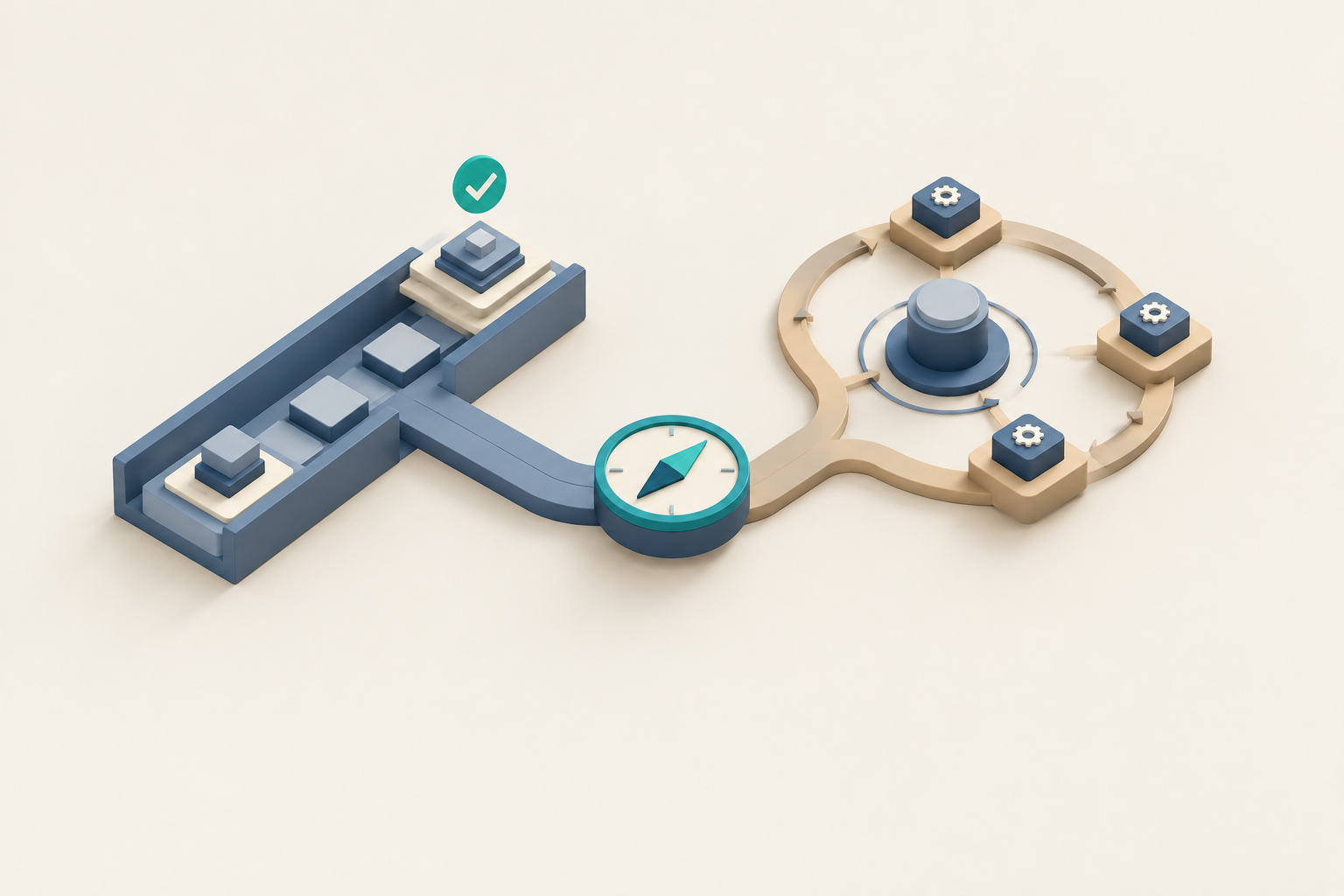
If you are planning a custom website, software build, or ongoing design work, the payment model matters almost as much as the work itself. A fixed-price project is best when the finish line is clear. A retainer is better when the work will keep changing after launch. The quickest way to choose is to ask: can we describe the end result clearly now, or are we still making decisions as we go?
Start with the shape of the work
A fixed-price project works when you can describe the finished thing before work starts. That might be a new website, a customer portal, a brand identity, or a one-off audit.
A retainer works when the work is ongoing. That usually means the site is live, new pages keep coming up, small fixes keep appearing, or you want a team on call for design and development each month.
If the job has a clear start and end, treat it like a project. If it will keep moving, treat it like a retainer.
Questions that point to a project
Ask whether you can write a clear scope without guessing. If you can list the pages, features, roles, or deliverables, a project is probably the right shape.
Ask whether there is a real finish line. If the work is a launch, rebuild, portal, identity system, or audit, that is usually project work.
Ask whether the budget needs to be known up front. Fixed-price work gives you one agreed cost before the build begins, which helps when you need certainty and a defined scope.
Questions that point to a retainer
Ask whether the work changes every month. A site that keeps needing new pages, fresh content, SEO updates, or small product changes is usually a better fit for a monthly block of time.
Ask whether speed matters more than a new scope every time. A retainer can remove the stop-start cycle of re-briefing and waiting for a new quote.
Ask whether one team knowing the system is a real advantage. When the same people keep working on the same site or app, they do not have to relearn the setup each time.
What to ask before you sign anything
What is included, and what is not? This matters for both models. On a project, it keeps scope from quietly growing. On a retainer, it keeps the monthly hours or tasks clear.
Who owns the code, files, domain, hosting, and accounts? ARG says those should be in your name from day one, with handover as the default.
What happens after launch? A project should include a support window. A retainer should define how requests are handled, how quickly work is queued, and what counts as part of the monthly block.
What does success look like? For a website, that might be faster pages, better structure, or clearer calls to action. For software, it might be fewer manual steps, fewer status calls, or fewer duplicate entries.
The trade-offs in plain language
A project gives you certainty. You get a written scope, a fixed price, and a clear end. The trade-off is that changes outside the scope need a new decision.
A retainer gives you flexibility. You get ongoing help without starting over each time. The trade-off is that the work needs ongoing priority and a steady flow of requests to make sense.
Neither model is better in every case. The right one is the one that matches how stable the problem is.
A simple rule you can use today
Choose a project if you can say, 'We need this thing built.'
Choose a retainer if you can say, 'We need someone to keep improving this thing.'
If you are still unsure, describe the problem in plain language and ask the studio to tell you which bucket it belongs in. That is often the fastest way to avoid paying for the wrong shape of work.